Implementing Workday in a New Organization: The Complete Playbook
- Pranav Padmane
- 3 days ago
- 4 min read

Implementing Workday in a new organization is one of the most impactful technology decisions an HR or Finance leadership team can make. Done right, it unifies people data, financial data, and operational workflows into a single cloud platform that scales with the business. Done poorly, it becomes a costly, multi-year remediation effort. This playbook covers everything you need to know — from the first project planning conversation to post-go-live steady state.
The six Workday modules you need to scope
A typical Workday implementation for a new organization covers six core modules: Workday HCM (core HR, org management, and absence), Workday Payroll (pay calculation, tax configuration, and direct deposit), Benefits Administration (open enrollment, carrier integrations, and ACA compliance), Workday Financials (general ledger, accounts payable, accounts receivable, and procurement), Talent and Performance (recruiting, goal setting, performance reviews, and succession planning), and Integrations (Workday Studio pipelines, EIB inbound/outbound, REST/SOAP APIs, and RaaS scheduled reports).

Phase 1: Project initiation and planning (Months 1–2)
The foundation of any Workday implementation is strong governance. This phase establishes the executive sponsor and steering committee, defines the project charter and scope, builds the RACI matrix, selects the implementation partner, and locks the baseline timeline and budget. A risk register should be started on day one — not after the first issue surfaces.
Phase 2: Requirements and fit-gap analysis (Months 2–3)
Before a single Workday tenant is provisioned, the team maps current-state HR and finance processes, runs requirements workshops for each module, and conducts a formal fit-gap analysis against Workday's standard capabilities. The critical decision log — which needs will be met through configuration and which truly require customization — must be approved by both the solution architect and executive sponsors.
Phase 3: Tenant provisioning and configuration (Months 3–5)
Workday sandboxes and the production tenant are provisioned by the implementation partner. Enterprise structure configuration — organizations, supervisory orgs, locations, and cost centers — is the foundational work that every other configuration builds on. Security and role-based access design happens in parallel. HCM, Financials, Benefits, and Payroll configuration all begin in this phase and continue into Phase 5.
Phase 4: Data migration and conversion (Months 4–8)
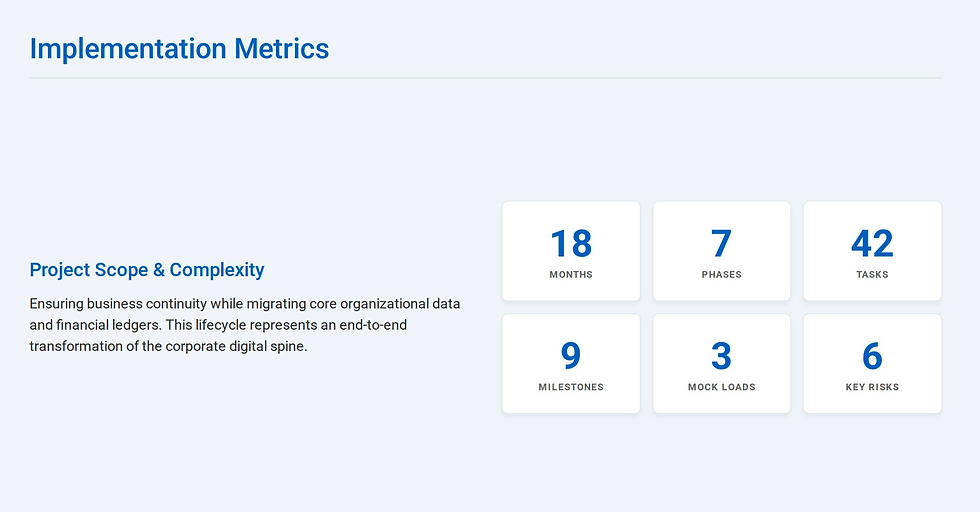
Data migration is where most Workday implementations either succeed or struggle. The process involves a source system audit, data cleansing and deduplication, mapping legacy data to Workday's data model, and three structured mock loads with full reconciliation. Mock load one covers workers and positions. Mock load two adds history and compensation. Mock load three is a full dress rehearsal that validates every object end-to-end. Business sign-off on data accuracy closes this phase.
Phase 5: Integrations and reporting (Months 5–9)
Workday rarely operates in isolation. Payroll processors, benefits carriers, applicant tracking systems, finance platforms, and banking integrations all need to connect. This phase maps the integration landscape, designs Workday Studio pipelines and EIB specifications, builds and tests each integration, and constructs Workday reports and dashboards for HR and Finance leaders. Integration complexity is consistently underestimated — building a proof-of-concept for payroll integration in month four (not month nine) is one of the highest-value risk mitigations available.
Phase 6: Testing — SIT and UAT (Months 9–12)
System Integration Testing validates that the Workday configuration, integrations, and data loads all work together as a system. User Acceptance Testing brings real business users — HR business partners, payroll coordinators, finance analysts — into the process to validate their day-to-day workflows. A parallel payroll run is non-negotiable before go-live. Defects are triaged, remediated, and retested in a structured cycle before UAT sign-off.
Phase 7: Change management and training (Months 7–13)
Change management is not a phase — it is a parallel workstream that runs from month one through hypercare. A change impact assessment identifies which teams are most affected. A communication plan keeps the organization informed through every milestone. Role-based training curricula and job aids are built by the L&D team. A train-the-trainer program equips internal super-users to support their colleagues after go-live.
Phase 8: Cutover, go-live, and steady state (Months 13–14)
The cutover plan and runbook define every step of the go-live weekend in sequence, with owners, time estimates, and rollback triggers. A cutover rehearsal validates the runbook in a controlled environment. The final data migration load converts the organization into Workday over a planned downtime window. A 30-day hypercare period follows, where the full project team supports production issues before handing off to HR operations and IT support.
Six critical success factors
First, lock scope before configuration begins — scope creep is the number one budget and schedule risk. Second, audit your data quality early — bad data found at cutover is catastrophic. Third, run three mock data loads with full reconciliation. Fourth, prototype payroll and benefits integrations in month four. Fifth, assign a dedicated OCM lead and start communications from project kickoff. Sixth, use Workday Community and your implementation partner's accelerators — there is no need to configure standard processes from scratch.
Final thoughts
A Workday implementation is a 14-month partnership between your organization and the technology. The teams that succeed treat it as a business transformation, not an IT project. They invest in governance from day one, protect the scope, run change management as a first-class workstream, and hold the line on data quality. The result is a Workday environment that genuinely serves the business — and that the organization feels ownership of from the moment it goes live.

Comments