How I Managed a Project with No Clear Scope
- Pranav Padmane
- Apr 19
- 3 min read

“Build us an AI solution to understand our customers better.” That was the entire project brief. No data requirements, no model specifications, no definition of “better,” no success metrics. Just a mandate from the C-suite who’d read one too many articles about ChatGPT and wanted their own “AI thing.”
I was assigned as the project lead for what would become a four-month AI product development initiative, but on day one, I didn’t know if we were building a chatbot, a recommendation engine, a sentiment analyzer, or all three.
The Problem
AI projects without clear scope are uniquely dangerous. Unlike traditional software projects, stakeholders often don’t understand what AI can and cannot do. Marketing wanted an AI that “predicts what customers want before they know it.” Sales wanted real-time lead scoring. The data team wanted time to build proper pipelines. Leadership wanted it deployed “next quarter.”
Everyone assumed AI was magic that would just “figure things out.” Nobody had articulated actual business metrics, model accuracy requirements, or data availability.
The Solution: The AI Scope Framework
I stopped waiting for clarity and treated scope definition as a structured discovery process. AI projects need four dimensions of scope that traditional projects don’t: Use Case, Data, Model, and Deployment.
Week 1–2: Use Case Discovery
I ran targeted workshops asking stakeholders to describe specific scenarios, not aspirations:
“Show me a customer interaction where this AI would help”
“What decision would you make differently with this insight?”
“How would you measure if this AI is working?”
This exposed the real need: Sales teams were manually scoring leads by reading customer emails and call transcripts. They wanted AI to automate lead scoring based on engagement signals.
Week 3: The Data Reality Check
Here’s where most AI projects fail. I audited what data actually existed:
✓ CRM data (clean, structured)
✓ Email interaction logs (messy but usable)
✗ Call transcripts (didn’t exist — would need speech-to-text)
✗ Customer purchase history (in legacy system, 6-month integration timeline)
I presented this to stakeholders with a critical question: “Given what data we have TODAY, what AI can we actually build in your timeline?”
Week 4: The Tiered Scope Proposal
I created a three-tier proposal based on data availability and complexity:
TIER 1 — MVP (8 weeks)
Lead scoring using CRM data + email engagement
Simple ML model (logistic regression/random forest)
Batch predictions, manual review workflow
Success metric: 70% accuracy vs. manual scoring
TIER 2 — Enhanced (16 weeks)
Add sentiment analysis from email content
Integrate basic call metadata (duration, frequency)
Real-time scoring API
Success metric: 80% accuracy + 50% time savings
TIER 3 — Advanced (24+ weeks)
Full speech-to-text integration
Deep learning models
Automated scoring with confidence intervals
Success metric: 85%+ accuracy, fully automated workflow
[Space for diagram: A three-tier pyramid showing MVP, Enhanced, and Advanced AI capabilities with timelines and data requirements at each level]
Week 5: The AI Scope Contract
I created a two-page scope document that included AI-specific elements:
Model performance baseline: Current manual accuracy rate (65%)
Target accuracy: 70% for MVP (not 100% — managing AI expectations)
Training data requirements: Minimum 10,000 labeled leads
Exclusions: Real-time predictions, call transcript analysis, predictive analytics beyond lead scoring
Model refresh cadence: Monthly retraining
Human-in-the-loop requirements: Sales team reviews all “borderline” scores
I got stakeholder signatures acknowledging that AI models aren’t perfect and require ongoing maintenance.

Pgase 2 —
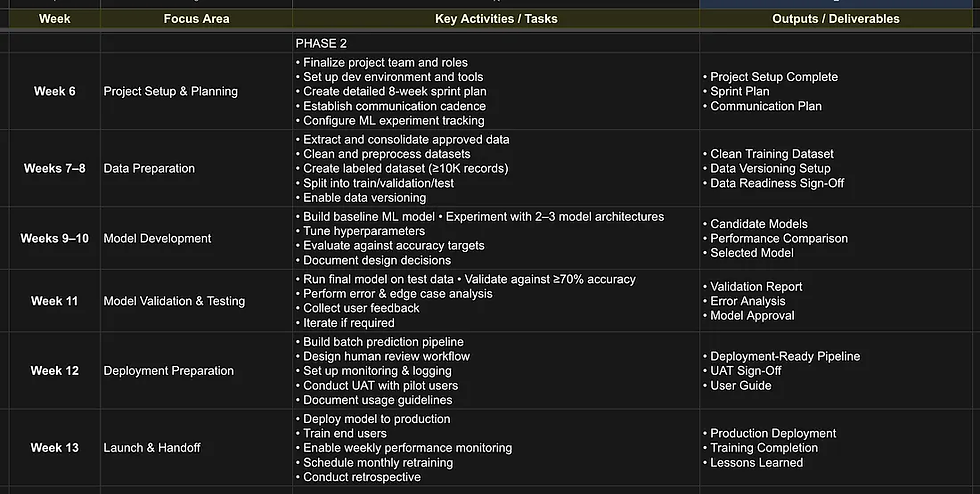
Pgase 2 —
The Results
With documented scope by week five, we built and deployed the MVP in 7 weeks. The model achieved 72% accuracy — exceeding our target. Sales teams saved 15 hours per week on lead qualification.
More critically, when executives asked “Can the AI also predict customer churn?” I referenced the scope document and said, “That’s a different use case requiring different data and models. Let’s scope it as Phase 2.”

Comments